Importance of Validated Learning
The heart of modern software engineering lies with effective learning and responsibly managing complexity. For both aspects, the validated learning loop is the most important tool at our disposal.
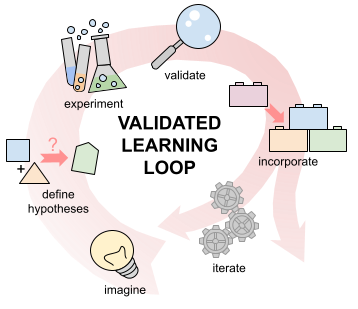
Learning, a fundamental skill
Software engineers must be able to learn effectively because we employ various technologies and develop supporting applications for a wide range of problem domains. The latter aspect, in particular, demands the ability to rapidly build understanding of complicated organizational processes and business operational principles.
To build software and integrations across systems that feel natural and are maintainable (ergo, are understandable), it is important to measure and validate whether an approach leads to improvements and decreases the pressures on a team. By approaching every line of code and every release as an experiment, we continuously validate our vision and learn to understand and support operational processes better and better.
As a result, we see the validated learning loop crop up, again and again, in our daily work.
Test Driven Development
TDD, a powerful approach to software design and implementation, embraces this principle in very short feedback loops. By writing tests before writing code, we formalize the hypothesis and make our assumptions explicit. Only then do we write the code to meet the tests. To close the loop, we run the tests against the code to see if they succeed. This is the experiment phase, where our expectations are confronted with reality. If the tests succeed, we adopt and integrate the new code in the product. Where necessary, we apply refactoring to iterate and improve the code we wrote.
Continuous Delivery & Lean Startup
Continuous delivery and lean startup methodologies also embed the validated learning loop to streamline the software delivery process. By delivering small sets of new functionality to the customer in rapid iterations, a release can be used as part of an experiment: If we consider how to measure the impact of a release before we deploy it, we can begin to make data-driven decisions about our software.
Evaluation & Retrospection
The validated learning loop does not only play a role in our development process, but also in the evaluation thereof. A team that is able to use its retrospectives and sprint reviews to formulate hypotheses about the risks and friction they encounter in their delivery process. With these insights, they can come up with improvements in a structured manner and even propose ways to validate that their new approach works!
DORA Metrics
A solid start for measuring and validating the software development process is to look at the DORA metrics. These metrics measure how quickly a team can deliver value to its customers, how many releases result in problems and how effectively a team responds to them. This can provide crucial insights if a team wants to move towards further automation and streamlining of delivery of their product.
Conclusion
In short, the validated learning loop can be found everywhere in modern software engineering. Awareness of this idea among software engineers permits them to reflect on their process, environment and product.
As such, learning (and building validation cycles into everything you do) is one of the most important skills an engineer can learn.